
Bleeding Gums: Is It Gum Disease, and What Should You Do?

"My gums bleed when I brush. Is that normal?"
Common, yes. Normal, no. Healthy gums do not usually bleed. The most frequent reason they do is plaque left along the gumline, which irritates the gum and makes it inflamed. The good news: at this early stage the problem is often reversible.
The three stages of gum disease
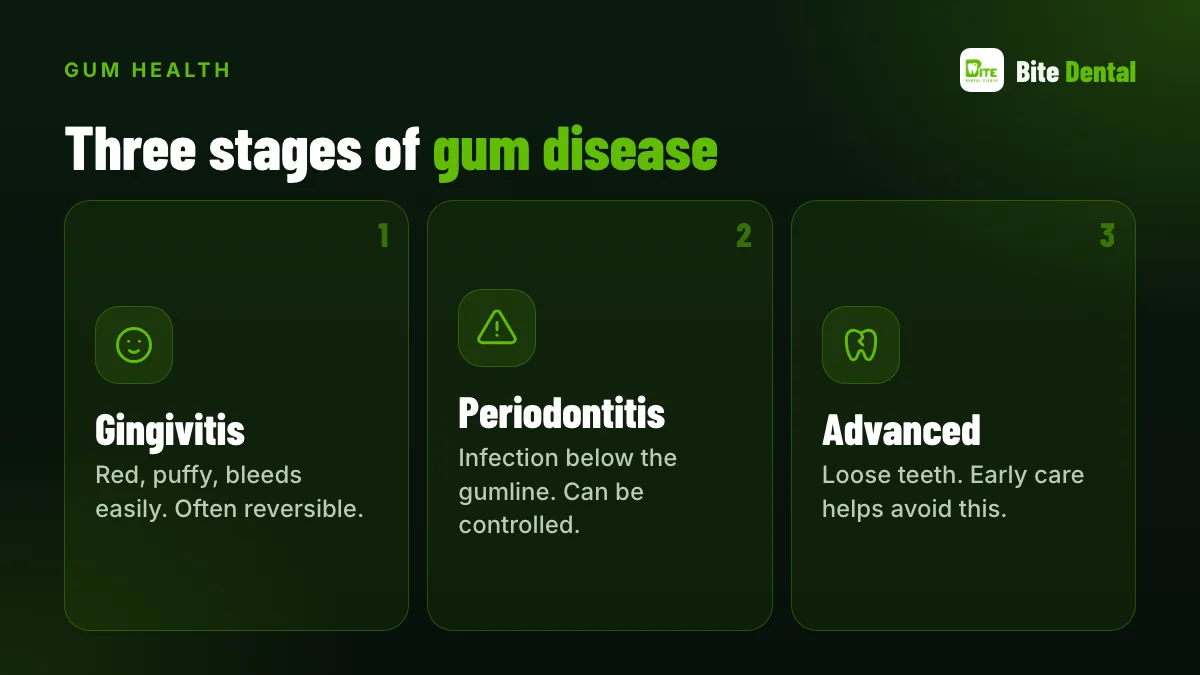
1. Gingivitis (early). Gums look red or puffy and bleed easily. There is no bone loss. With good cleaning and a professional scale, gingivitis can often be reversed.
2. Periodontitis (established). The infection reaches below the gumline and begins to damage the bone and tissue that hold teeth. Gums may pull back, pockets form, and breath can smell. This stage can be controlled but the lost bone does not simply grow back.
3. Advanced periodontitis. Teeth may become loose or shift, and some may need to be removed. Early treatment helps avoid getting here.
Gum disease is often painless in its early stages, which is why people leave it for years. That is exactly why bleeding is worth acting on.
Common causes of bleeding gums
- Plaque and tartar build-up (the most common cause)
- Brushing too hard with a hard-bristled brush
- Starting to floss after a long gap (it may bleed for a week or so, then settle)
- Hormonal changes, such as pregnancy
- Smoking and tobacco, which can actually hide bleeding while making disease worse
- Some medicines, such as blood thinners
- Health conditions, including diabetes and, rarely, blood disorders
What you can do at home
- Brush twice a day with a soft brush at a 45-degree angle to the gumline, using small gentle circles.
- Clean between your teeth daily with floss or interdental brushes. This is where most gum disease starts.
- Keep going if it bleeds a little at first. Gums usually improve within one to two weeks of proper cleaning.
- Stop tobacco if you can. It is one of the biggest risk factors.
- Do not rely on mouthwash alone. It does not remove plaque.
What we do at the clinic
- Examine your gums and measure pocket depths with a small probe.
- X-rays where needed to check bone levels.
- Professional cleaning (scaling) to remove tartar you cannot brush off.
- Deeper cleaning (root planing) if there are pockets, usually in sections and with local anaesthesia.
- Teach you a technique that fits your mouth and review progress.
Not every case needs surgery. Many people only need a good clean and a better routine. We will tell you honestly which stage you are at.
Red flags: do not wait
See a dentist soon if you notice:
- Gums that bleed for more than two weeks despite good brushing
- Gums pulling back, or teeth looking longer
- Loose or shifting teeth
- Persistent bad breath or a bad taste
- Pus, or a painful swollen area of gum
Facial swelling or fever needs urgent attention.
Gum health affects more than your mouth
Research links severe gum disease with conditions such as diabetes, and well-controlled gums can make blood sugar easier to manage. It is another reason to treat bleeding as a message from your body, not an annoyance. For a broader prevention routine, see our guide to cavities and prevention.
Book a gum check at Bite Dental: A-52, Meera Bagh, New Delhi 110087 (+91 75339 51611) or MedHarbour Hospital, 1st Floor, Room 222, Sector 51, Gurugram 122003 (+91 98106 64561). Open Monday to Saturday, 10 am to 8 pm. This article is general information and not a substitute for an examination.