Teeth Cleaning (Scaling): What Happens and How Often You Need It
Common worry: "Won't scaling damage my teeth?"
It is one of the most common myths we hear. Professional scaling does not damage healthy enamel. It removes the hard deposits (tartar or calculus) that brushing cannot remove. If your teeth feel a little sensitive or look a bit "gappy" afterwards, that is usually because the tartar that was filling the spaces is gone and your gums are settling.
Plaque vs. tartar
- Plaque is a soft, sticky film of bacteria that forms on teeth every day. Brushing and flossing remove it.
- Tartar is plaque that has hardened. It sticks firmly to teeth and cannot be brushed off. It irritates the gums, can cause bleeding and bad breath, and gives plaque a rough surface to cling to.
What happens during a cleaning
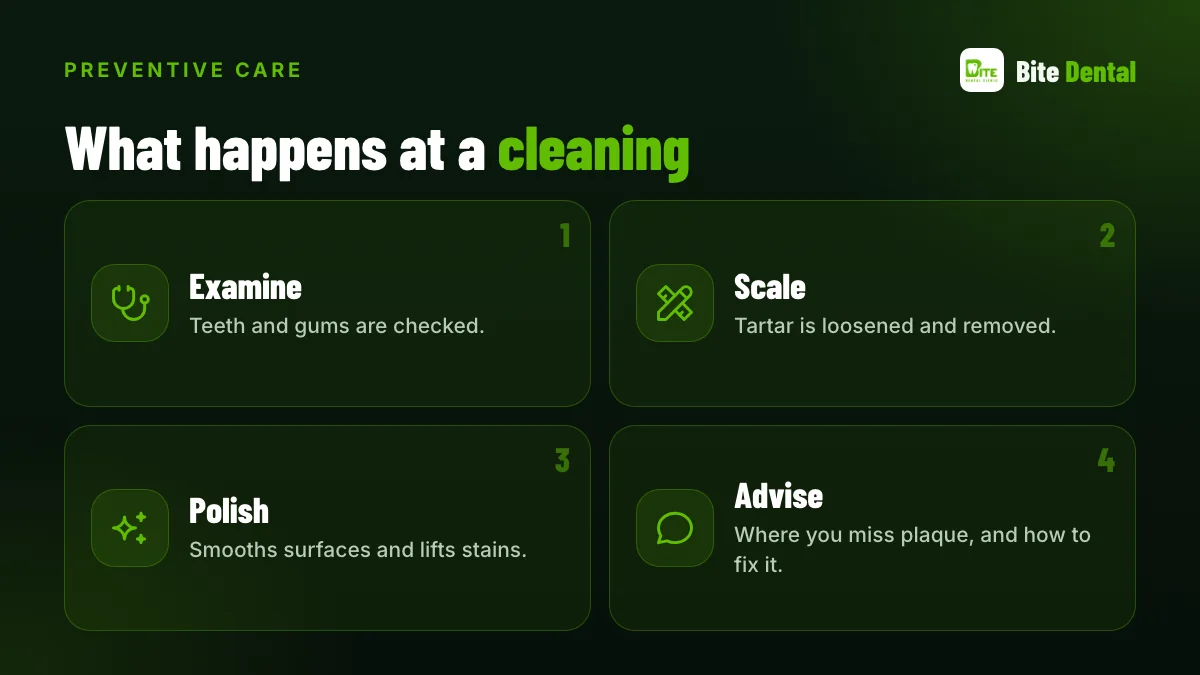
- Examination. We check your teeth and gums and look for cavities or signs of gum disease.
- Scaling. An ultrasonic scaler vibrates and sprays water to loosen tartar, and hand instruments finish the job.
- Polishing. A gentle polish smooths the surfaces and removes surface stains.
- Advice. We show you where you are missing plaque and how to clean those areas.
Most routine cleans are comfortable. If your gums are sore, tell us. Numbing gel or local anaesthesia is available if needed.
How often should you get it?
There is no single answer. Many people do well with a check and clean every six months, but some need it more often, for example:
- People with gum disease or a history of it
- Smokers and tobacco chewers
- People with diabetes
- People with braces or aligners
- Those who build tartar quickly
Others with excellent hygiene may do well with fewer. Your dentist will recommend an interval based on your gums, not a fixed rule.
What scaling does and does not do
It does:
- Remove tartar and surface stains
- Help gums heal and bleed less
- Freshen breath when plaque and tartar are the cause
It does not:
- Whiten teeth beyond removing surface stains
- Treat advanced gum disease on its own, which may need a deeper cleaning (root planing)
- Replace daily brushing and flossing
If you want whiter teeth, see our teeth whitening page. If your gums bleed, read our guide to bleeding gums.
After a clean
- Mild gum tenderness or sensitivity for a day or two is common.
- Brush gently and keep cleaning between your teeth.
- Avoid very hot or cold food if your teeth feel sensitive.
- If bleeding or soreness continues beyond a few days, let us know.
Why it pays to keep up
Regular cleans help catch cavities, gum problems and other issues early, when they are simpler to treat. It is one of the easiest ways to keep your natural teeth for life.
Book a check-up and clean at Bite Dental: A-52, Meera Bagh, New Delhi 110087 (+91 75339 51611) or MedHarbour Hospital, 1st Floor, Room 222, Sector 51, Gurugram 122003 (+91 98106 64561). Open Monday to Saturday, 10 am to 8 pm. This article is general information and not a substitute for an examination.