Braces for Teenagers: What Is the Right Age to Start?
"Is my child too young, or too old, for braces?"
Parents often worry they are either starting too early or leaving it too late. The truth is that there is no single perfect age. The right time depends on the problem, your child's growth and how many adult teeth have come in.
Why age matters
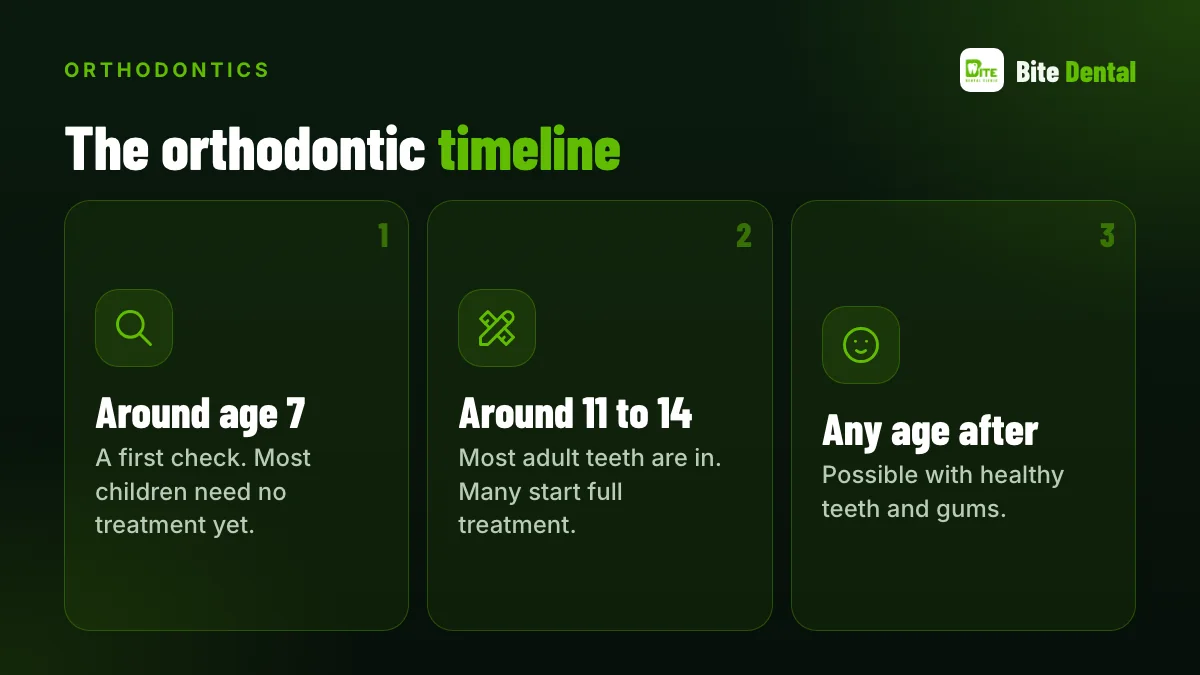
- Around age 7: a first orthodontic check is often suggested. Most children need no treatment yet. The aim is to spot issues such as a narrow jaw, a crossbite or harmful habits, where early guidance can make later treatment simpler.
- Around 11 to 14: most adult teeth are in, and many teens start full treatment. Growth is still active, which can help with certain bite corrections.
- Teens, young adults and adults: treatment is possible at almost any age if teeth and gums are healthy.
Starting later is not a failure. Some children simply need to wait until the right teeth have erupted.
Signs your child may need an orthodontic check
- Crowded, crooked or overlapping teeth
- Front teeth that stick out, or a bite where the upper teeth sit well in front of the lower
- Upper teeth that bite inside the lower teeth (crossbite)
- An open bite, where the front teeth do not meet
- Difficulty chewing or biting
- Thumb sucking or mouth breathing that continues past the usual age
- Baby teeth lost very early or very late
- Jaws that click or look uneven
These signs can have different causes, so only an examination and X-ray can tell what is needed.
Treatment options for teens
- Metal braces. Strong and reliable for complex bite problems, and a good fit for teens who might not wear removable appliances consistently.
- Ceramic braces. Less visible, tooth-coloured brackets.
- Clear aligners. Removable and discreet, but they work only if worn about 20 to 22 hours a day. They suit teens who are responsible about wearing them.
- Functional or expander appliances. Used in growing children to guide jaw development before or alongside braces.
Our guide to braces vs. aligners explains the differences in detail, and you can explore options on our braces and aligners page.
What parents can do
- Book an early check if you notice any of the signs above.
- Keep teeth clean. Brushing and flossing around braces takes effort. Interdental brushes help.
- Watch snacks. Sticky sweets, hard foods and frequent sugary drinks raise the risk of cavities and broken brackets.
- Support the routine. Remind teens about retainers, elastics and appointments.
- Protect the teeth with a mouthguard for sports.
How long does treatment take?
It depends on the case. Many teens are in braces for a year or two, and some need less or more. Your orthodontist will give you a realistic range after examining your child. Wearing retainers afterwards is essential to keep the result.
Will it hurt?
Teeth are usually sore for a few days after braces are fitted and after adjustments. Soft food and the painkillers your dentist advises usually manage this. Tell us if anything rubs or hurts and we will adjust it.
Book an orthodontic check with Dr. Aman Sachdev at Bite Dental: A-52, Meera Bagh, New Delhi 110087 (+91 75339 51611) or MedHarbour Hospital, 1st Floor, Room 222, Sector 51, Gurugram 122003 (+91 98106 64561). Open Monday to Saturday, 10 am to 8 pm. Timelines vary; this article is general information.