Wisdom Tooth Removal: When It Is Needed and When It Is Not
The myth that every wisdom tooth must go
Wisdom teeth (third molars) usually appear between ages 17 and 25. Some people have enough room and never have a problem. Others have teeth that grow sideways, stay trapped under the gum, or are hard to clean. The decision to remove a wisdom tooth should be based on your tooth, your X-ray and your symptoms, not on a rule.
Signs a wisdom tooth may need attention
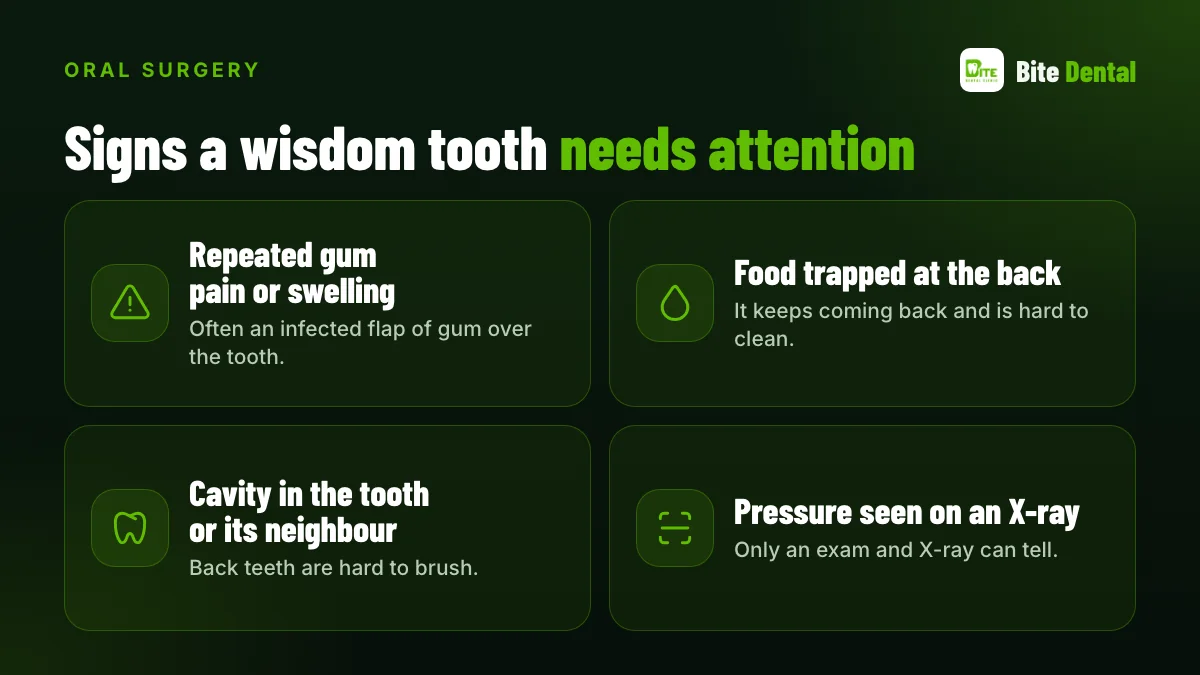
- Repeated pain or swelling in the gum at the back of the mouth. This is often pericoronitis, an infection of the gum flap over a partly erupted tooth.
- A cavity in the wisdom tooth or in the tooth in front of it, because these back teeth are hard to brush.
- Food trapped behind the second molar that keeps coming back.
- Gum or bone damage next to the second molar.
- Pressure on neighbouring teeth seen on an X-ray, or a cyst around the tooth.
- Bad taste or breath from the back of the mouth that does not go away.
These signs can have other causes, so an examination and an X-ray are the only way to know.
When we often say "leave it, but watch it"
If a wisdom tooth is fully erupted, can be cleaned properly, is healthy and not causing problems, removing it may not be necessary. We may suggest a periodic check with an X-ray instead. Impacted teeth with no symptoms are a judgement call, and we will discuss the pros and cons with you rather than push surgery.
How removal works
- Assessment and X-ray, often a 3D scan if the tooth is close to a nerve.
- Local anaesthesia to numb the area. Sedation can be discussed if you are anxious.
- Removal. A simple tooth may come out quickly. An impacted tooth may need a small opening in the gum and sometimes sectioning the tooth into pieces to make removal gentler.
- Stitches if needed, and clear aftercare instructions.
You should feel pressure and pushing, but not sharp pain. Tell us if anything hurts and we will top up the numbing.
Recovery: what is normal
- Soreness and mild swelling for a few days, often peaking around day two to three.
- Some oozing in the first 24 hours.
- Stiff jaw that eases over a week or so.
Helpful habits (follow your dentist's exact instructions):
- Bite on gauze as advised and rest on the first day.
- Use a cold pack on the cheek for short periods in the first day.
- Eat soft, cool food and avoid very hot drinks at first.
- Do not spit or rinse hard, and do not use a straw for the first few days.
- Avoid smoking and tobacco, which raise the risk of a painful dry socket.
- Take medicines only as your dentist advised.
When to call us
Call the same day if you have:
- Bleeding that will not stop with firm pressure
- Swelling that keeps getting bigger after day three
- Fever
- Severe pain that returns after the first few days (this can be a dry socket)
- Numbness that does not wear off
If you have trouble breathing or swallowing, go to an emergency room.
Why it helps to decide early
Removal is often more straightforward in the late teens and twenties, when roots are not fully formed and healing tends to be quicker. That said, it is never "too late" to have a problem tooth assessed. If a wisdom tooth is bothering you, or an X-ray at another clinic mentioned it, a second look is easy to arrange.
Book a wisdom tooth check at Bite Dental: A-52, Meera Bagh, New Delhi 110087 (+91 75339 51611) or MedHarbour Hospital, 1st Floor, Room 222, Sector 51, Gurugram 122003 (+91 98106 64561). Open Monday to Saturday, 10 am to 8 pm. This article is general information and not a substitute for an examination.