Am I a Candidate for a Dental Implant? What We Check First
"Can I get an implant?" is the question we hear most
When someone is missing a tooth, the first thing they ask is whether an implant is possible for them. The honest answer is: often yes, but it depends on a few things we can only confirm by examining you. This guide explains what we look at, so you know what to expect at a consultation.
An implant is a small titanium post placed in the jawbone that acts like a tooth root. A crown is then fitted on top. Our team has placed more than 3,000 implants across our West Delhi and Gurugram clinics, and the first step is always the same: find out whether an implant suits you.
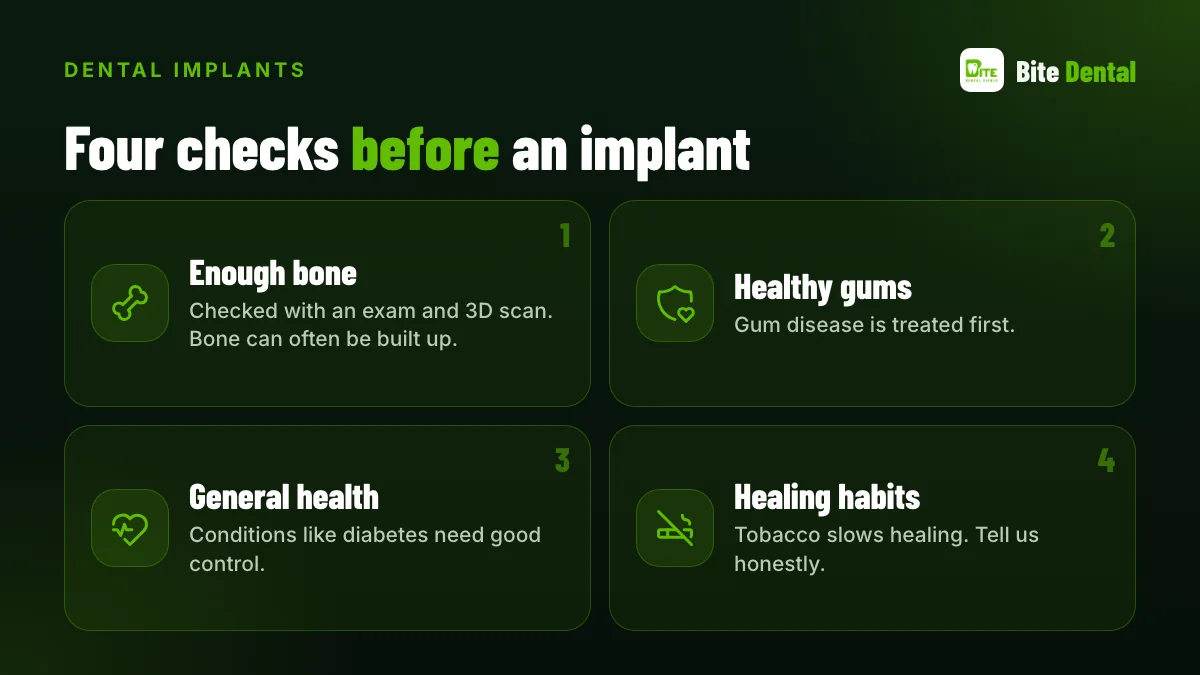
1. Enough healthy bone
The implant needs bone to hold onto. After a tooth is lost, the bone where the root used to be slowly shrinks, so the longer a gap has been there, the more this matters.
We check bone with an examination and a 3D scan (CBCT), which shows height, width and the position of nerves and sinuses. If bone is thin, it can often be built up with a bone graft or a sinus lift. This adds time to treatment, but it does not usually rule an implant out.
2. Healthy gums
Gum disease around an implant is a common reason implants run into trouble later. If you have active gum disease, we treat it first, then plan the implant. A clean, stable mouth gives an implant a good chance of lasting.
3. General health
Most healthy adults can have an implant. Some conditions need extra care and good control before surgery, for example:
- Diabetes: needs to be well controlled
- Heart conditions or blood thinners: your doctor may need to advise on medicines
- Osteoporosis medicines (bisphosphonates): tell us, as they affect how we plan
- Radiotherapy to the head or neck: needs a specialist discussion
Please bring a list of all your medicines. Nothing you tell us changes how we treat you; it only helps us plan safely.
4. Habits that affect healing
Smoking and tobacco (including gutka and chewed tobacco) slow healing and raise the chance of implant problems. If you use tobacco, quitting, even for a few weeks around surgery, improves your odds, and we will not judge you for being honest about it. Grinding your teeth at night is also worth mentioning, because it puts extra load on implants and a night guard may be advised.
Who is usually not ready yet?
- Children and teenagers. Implants are for adults whose jaw growth is complete.
- People with uncontrolled medical conditions. We would wait until they are stable.
- Anyone with active infection or untreated gum disease. We treat this first.
"Not ready yet" is different from "never". Many of these situations can be improved so that an implant becomes possible later.
What if an implant is not the right choice?
Implants are one option, not the only good one. Depending on your mouth, a bridge, a partial denture or simply monitoring may suit you better. We will explain the pros and cons of each in plain language, and we will tell you if we think another option is a better fit. You can read more on our dental implants page.
What happens at the consultation
- We listen to your history and what you want to achieve.
- We examine your teeth, gums and bite.
- We take X-rays and, where needed, a 3D scan.
- We explain what is possible, how long it would take, and what each option involves.
- You decide. There is no pressure to start the same day.
If you have been told you "don't have enough bone" elsewhere, a second opinion with a 3D scan is often worthwhile.
Book an implant consultation at Bite Dental: A-52, Meera Bagh, New Delhi 110087 (+91 75339 51611) or MedHarbour Hospital, 1st Floor, Room 222, Sector 51, Gurugram 122003 (+91 98106 64561). Open Monday to Saturday, 10 am to 8 pm. This article is general information and not a substitute for an examination.